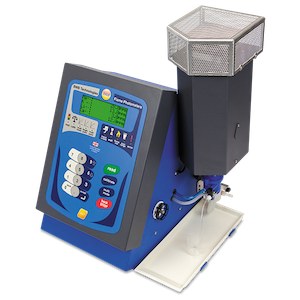
BWB XP Flame Photometer
BWB's flagship five-channel flame photometer that measures and displays sodium, potassium, lithium, calcium and barium at the same time, with no filter changes between elements.
View product


Reference: BWB-BIO + AFHS
The clinical BWB BIO flame photometer combined with BWB's autosampler and auto-diluter for automated serum and urine Na, K, Li and Ca analysis of up to 89 samples.
Key specifications
BWB BIO with Automated Fluid Handling System (AFHS)
Request a quoteOverview
This system pairs the BWB BIO clinical flame photometer with BWB's Automated Fluid Handling System (AFHS), which was originally designed around the BIO. It is intended for biological laboratories with high sample throughput, where serum and urine samples would otherwise have to be introduced by hand one at a time.
BWB's auto-read firmware determines reading stability analytically, so the run can proceed without an operator deciding when to accept a result. The autosampler holds up to 89 samples on interchangeable trays, and the auto-diluter is configurable from 1:6 to 1:100. Each sample takes about 130 seconds with dilution (around 25 per hour) or 80 seconds without (around 40 per hour).
The BIO measures Na and K, or Li and Ca, in serum and urine in mmol/L. A thermal printer mounted on the photometer gives on-demand hard copies, the dilution reservoir is 2.5 L with low-level control (5 L optional), and the AFHS works with BWB flame photometers made from 2014 onward.
Specifications
26 parameters
The AFHS was originally developed for BWB's clinical BIO flame photometer.
Stability of each reading is decided by firmware, not the operator.
Interchangeable trays to speed up batch changes.
Operator-set dilution from 1:6 to 1:100.
Serum and urine Na, K, Li and Ca reported in mmol/L.
Integrated thermal printer for key analysis data.
Al-Shaker specifies the configuration, documents the system, and supports it across Jordan, the GCC, and MENA.
Consult
Plan
Supply
Install
Train
Support
BWB's flagship five-channel flame photometer that measures and displays sodium, potassium, lithium, calcium and barium at the same time, with no filter changes between elements.
View product
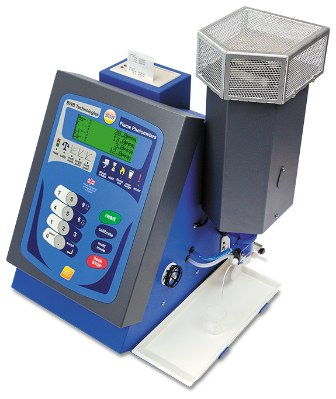
Four-channel flame photometer built on the XP platform that reads Na, K, Li and Ca together and adds a caesium or lithium internal reference standard.
View product
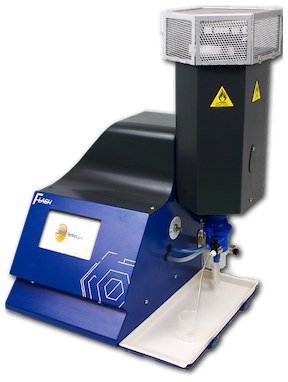
Configurable flame photometer with a 5-inch touchscreen, built-in compressor and gas regulator, offered in seven models from single-element to four-element (Na, K, Li, Ca).
View product
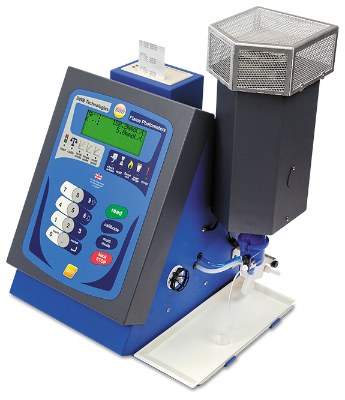
Clinical and research flame photometer for blood serum and urine, measuring Na and K or Li and Ca against supplied 5-point serum and urine calibration standards.
View product
Talk to the technical team
Share the workflow, capacity, and compliance constraints. We respond with a recommended configuration, not a generic catalogue list.