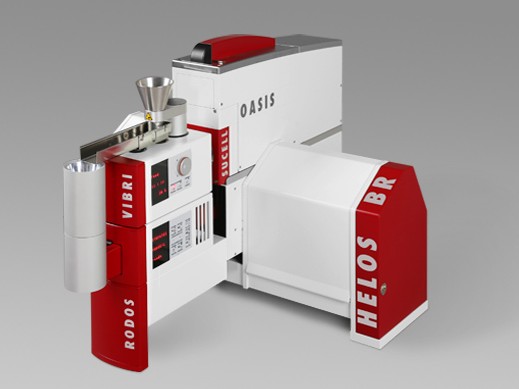
Sympatec Laser Diffraction Systems
HELOS laboratory and MYTOS process laser diffraction for powders, granules, suspensions, emulsions, and sprays from below 0.1 µm to 8,750 µm.
View product


Reference: OPUS-FT off-line
OPUS ultrasonic extinction sensor in a standby rack with flow-through adapter for laboratory and pilot-plant analysis of small quantities of suspensions, emulsions, pastes and slurries.
Key specifications
OPUS-FT off-line laboratory set-up with standby rack
Request a quoteOverview
In this off-line configuration the OPUS sensor is elevated in a standby (SB) rack together with a flow-through adapter. With a peristaltic laboratory pump, storage tank and piping it forms a sample circuit that circulates roughly 300 ml to several litres. For dispersions that do not separate, about 50 ml is enough without a pumped circuit.
It measures particle size from below 0.1 to 3,000 µm and concentration of suspensions, emulsions, pastes and slurries up to 70 vol%, and connects flexibly to 10 mm hose or DN10 to DN25 pipe set-ups from laboratory to pilot scale. Optional adapter flanges with ball valve, hose connection or funnel are available.
Specifications
6 parameters
Flexible sample circuits and test set-ups.
Up to 70 vol%.
About 50 ml for stable dispersions.
Ball valve, hose connection or funnel.
Al-Shaker specifies the configuration, documents the system, and supports it across Jordan, the GCC, and MENA.
Consult
Plan
Supply
Install
Train
Support
HELOS laboratory and MYTOS process laser diffraction for powders, granules, suspensions, emulsions, and sprays from below 0.1 µm to 8,750 µm.
View product
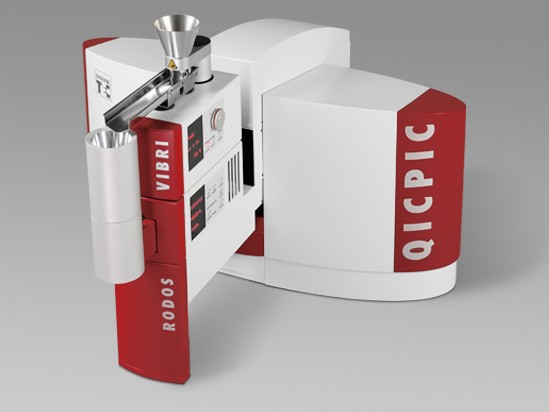
QICPIC laboratory and PICTOS process image analysis for particle size and shape from 1 µm to 34,000 µm.
View product
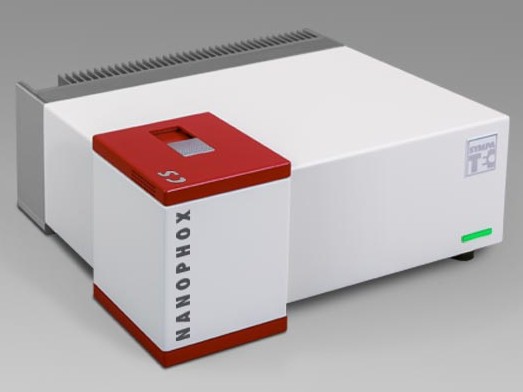
Photon cross-correlation (PCCS) for nanoparticles in turbid suspensions and emulsions from 0.5 nm to 10,000 nm, without extreme dilution.
View product
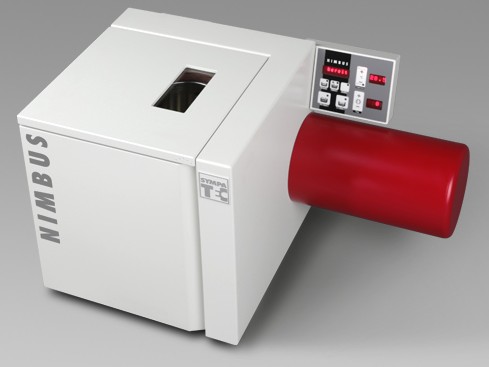
NIMBUS laboratory and OPUS process analysers for particle size and concentration in suspensions and emulsions from below 0.1 µm to 3,000 µm.
View product
Talk to the technical team
Share the workflow, capacity, and compliance constraints. We respond with a recommended configuration, not a generic catalogue list.